
TPM Attends LVMPD Unhoused CompStat Meeting

By: Leilah Ortega
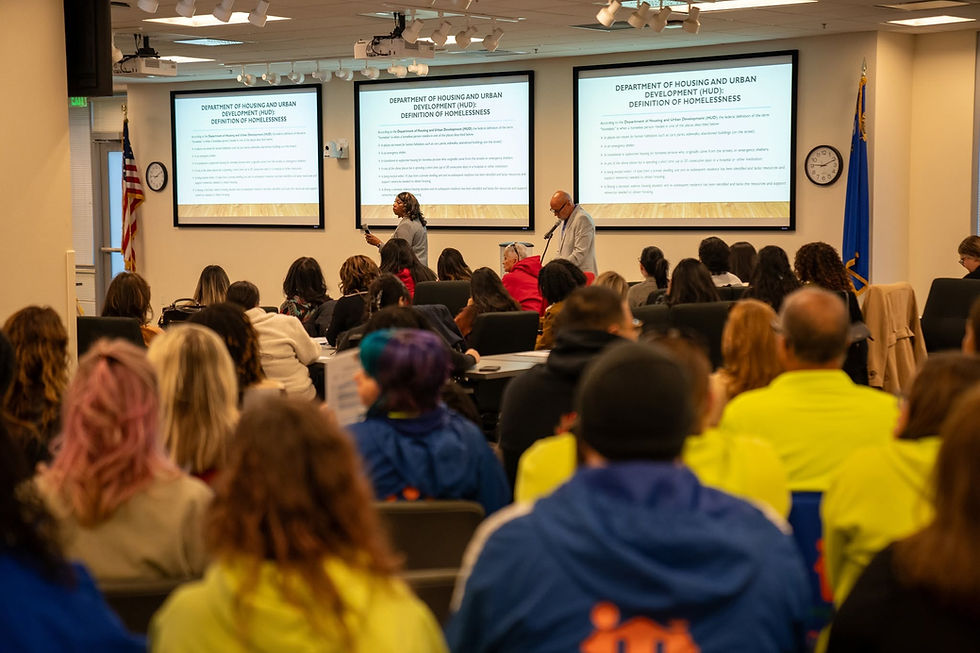
Several TPM members attended LVMPD’s Unhoused CompStat meeting last Wednesday at LVMPD Headquarters in the Historic Westside.
LVMPD launched Homeless CompStat as a “collaborative initiative designed to unite homeless service providers, community members, and law enforcement in a concerted effort to tackle homelessness more effectively” in 2025. LVMPD later renamed the initiative to Unhoused CompStat.
During the meeting, LVMPD provided updates on the progress of Unhoused CompStat through a variety of programs and initiatives executed by several departments. Speakers from these departments explained their role in assisting the unhoused community, including the LVMPD's Office of Community Engagement, LVMPD's Southern NV Counterterrorism Center, Clark County Detention Center, VA Southern Nevada Healthcare System, NV Department of Human Services, and Clark County's Election Department.
How LVMPD Says They're Solving the Problem
Officer Michael 'Wade' Murray, who works with the LVMPD's Southern NV Counterterrorism Center, led the first presentation emphasizing "terrorism" towards and within the unhoused community.
"If you have somebody who's homeless, people ignore them," Murray said. "They're just on the street; they don't really have much attention on them, which means they're the ideal source for a terrorist organization to use for doing any kind of observations, surveillance, photography...or attempted intrusion to a facility or organization."
Murray ended his presentation urging organizations to report violence to the Southern Nevada Counterterrorism Center.
Officer Teddi Hayes from the Clark County Detention Center followed, acknowledging her previous mistakes when it came to perceiving the unhoused community.
"I am not afraid to take accountability for my actions, and what I mean by that is, I've been a part of the problem,"
Officer Hayes said. "I have been a part of the problem; I have looked at our [unhoused] population and thought that they were less than, because of their crimes. Because of their addictions, because of the issues that they had."
Hayes continued by highlighting LVMPD's Detention Services Division's (DSD) C.A.R.E.S. program, created to lower recidivism. The DSD C.A.R.E.S. program works with different organizations to support incarcerated individuals before release. These organizations provide incarcerated individuals with resources to secure housing, identification, and healthcare.
Kelly Rupp and Liz Jarman of the VA Southern Nevada Healthcare System presented how they support unhoused veterans.
"Part of our work comes out of the idea...that no veteran should be unhoused in the country that you swore to serve," Rupp said.
Three types of housing intervention for unhoused veterans currently exist, including Supportive Services for Veteran Families (SSVF), GPD/HCHV, and HUD-VASH. Each program consists of short-term and permanent housing and support.
Other programs created to help unhoused veterans include the Veterans Justice Program, Veterans Justice Outreach, Veterans Treatment Court, and Health Care for Re-entry Veterans. Rupp and Jarman also said they collaborate with HELP of Southern Nevada, the Southern Nevada Health District's Street Medicine Team, U.S. Vets, the Salvation Army, and other organizations.
Geri Inciso of the NV Department of Human Services presented on the upcoming changes to Medicaid that could potentially affect unhoused individuals.
New requirements for Medicaid, which will take effect in 2027 following Trump's "One Big Beautiful Bill Act", will impact those aged 19-64, requiring able-bodied individuals in the age group to work, go to school, or get involved with community service for at least 80 hours a month to keep Medicaid status. Other changes include frequent renewals, immigration restrictions, and shorter retroactive coverage.
Ashley Kennedy with Clark County Nevada's Election Department led the final presentation regarding how unhoused people can still vote in the upcoming midterm elections.
"What I want to here to talk to you about is, if you did not know, it's an election year," Kennedy said. "And, what I'm here to talk to you about is how those who are experiencing homelessness or currently unhoused can still vote, because not having a permanent residence does not impact your voting rights."
Those wishing to vote do not need an ID; they can use the last four digits of their Social Security number and must complete a paper application. Unhoused people can use the general area they reside where they live while applying. However, they still must include a reliable mailing address to receive their sample and mail ballot.
The last day to register with a Social Security number instead of an ID is October 6th.
With all the presentations finished, LVMPD thanked community members for showing up and ended the meeting.
TPM Reacts
Emilia Marquez, TPM's Director of Health Equity and Advocacy, appeared at the meeting to link with other organizations that could benefit TPM.
"I think it's very important to link to one another," Marquez said. "I feel like I was able to get some information, maybe not all the information I wanted."
Elyahkeem Douglas, TPM's Director of Technology and Operations, says he showed up to last Wednesday's meeting to explore different resources and understand LVMPD's perspective.
"[I'm] just trying to explore more options and really trying to see different perspectives from Metro's side of things, seeing what [they're] doing compared to what we're doing," Douglas said.
Douglas says LVMPD's solutions and handling of unhoused communities are tolerable.
"At least from what the meeting was, it seems like they're handling stuff okayish," Douglas said. Douglas then explained that Officer Murray's presentation regarding terrorism in the unhoused community contained details he did not personally agree with. "Yeah, didn't really agree too much on some of the things, but I do understand the purpose of it. So I am glad they are at least looking out for that in some regard."
TPM volunteer Rachel Baltes says she enjoyed the meeting, but felt LVMPD didn't provide all the information they could.
"It was a good meeting with good presentations for sure; and there's a lot of good organizations in town that were there," Baltes said. "It was nice to network. You know, just see everybody who's here, but the police are really a lot of homeless people's biggest barriers, like to care and actually getting off the streets. You know, the instability and the unsafety and their stuff being taken away and all that. So, I was hoping to get answers about that."
Community Resources
While LVMPD promises to support the unhoused community, there is no denying the distrust that permeates the community. Our Sidewalk Friends consistently tell stories of feeling scared, mistreated, and dehumanized by police officers. LVMPD made no mention of street sweeps during the meeting, which leaves our friends distraught. With already very few resources, their possessions, shelters, and sometimes pets are taken away with no explanation or support from local authorities. TPM would like to highlight these local resources that we trust.
Shine A Light Foundation is a non-profit that aids unhoused individuals living in the underground flood channels of Las Vegas. The organization aims to offer food and supplies to those living in the flood channels and offer Instant Placement with Access to Treatment and Housing (IPATH).
Las Vegas Recovery Hospital, located on the Saint Rose De Lima campus in Henderson (102 E. Lake Mead Pkwy 3rd and 4th Floor, 1990 Tower, Henderson, NV 89015), is a comprehensive medical care hospital dedicated to supporting long-term recovery for patients with complex medical conditions and substance use disorders. The hospital creates a safe and supportive environment for recovery, addressing patients' physical health and behavioral needs.
U.S. VETS Las Vegas' mission is to end veteran homelessness by providing housing assistance, homeless prevention services, mental health services, and employment services to local veterans. U.S. VETS operates three residential facilities and a community support office space in Las Vegas.
The Just One Project fights food insecurity by increasing access to food, resources, and services through its Food For All & Community Connect Programs. The two programs seek to provide support to local individuals and families via grocery assistance and housing support.
Fent Prevent, founded by local teen Levi Shaner, serves to help other teenagers understand the dangers of fentanyl through awareness, education, and prevention. Fent Prevent teaches teens that their drugs can be laced with fentanyl, leading to overdose and death.
The Wellness Foundation was founded by two local teens, Caitlyn and Chloe Kim, to end period poverty and menstrual stigma. The Wellness Foundation distributes wellness boxes with essential period products, hygiene supplies, and cosmetics to unhoused individuals, shelters, and schools.


Comments